
Posterior Chain for Runners: Glute Strength, Hip Stability and Running Longevity
Running looks simple from the outside. One foot lands, the other swings through, and the body moves forward. Underneath that rhythm, every stride asks the body to accept force, control it, and then produce force again on one leg.
That is why running and sport are not only about having a big engine. Your body also needs the strength and stability to control that engine, step after step, session after session.
For runners, field-sport athletes, and anyone who wants to move well for years, the posterior chain and lateral hip muscles deserve attention. They help drive propulsion, support efficient mechanics, and build the physical capacity needed to tolerate training.
This is where posterior chain for runners, glute strength, and hip stability for runners all connect.

What the posterior chain is and why runners need it
The posterior chain is a simple name for the muscles along the back side of the body. For runners and athletes, the key areas include:
Glutes
Hamstrings
Calves
Spinal and hip musculature
These muscles work together to extend the hip, stabilise the trunk and pelvis, control landing forces, and help propel the body forward.
Think of the posterior chain as part of the body’s drive system. When the foot contacts the ground, the body has to manage impact and create forward movement. The glutes and hamstrings help extend the hip. The calves contribute to ankle stiffness, elastic rebound, and push-off. The deeper hip and spinal muscles help keep the pelvis and trunk organised so force can transfer cleanly.
In running, that transfer matters. If the hip, pelvis, or trunk cannot control movement well, force leaks into places that may be less prepared to handle it. The body may still find a way to keep moving, but it might use less efficient strategies.
That does not mean everyone needs to look identical when they run. Running styles vary. But most runners benefit from being able to:
Create force through the hips
Maintain control when landing on one leg
Keep the pelvis reasonably stable under load
Use the calves and feet as part of a strong lower-limb spring
Tolerate repeated training stress over time
Good strength training for runners should support these qualities, not just chase sore muscles or complicated exercises.
Running is repeated single-leg force control
Every stride is a single-leg task. The stance leg accepts body weight, controls ground reaction forces, and helps create the next step. This happens thousands of times in a normal run.
That is why running longevity is about more than fitness. Aerobic capacity matters, but tissues also need enough strength and capacity to handle the work. Muscles, tendons, joints, and the nervous system all adapt to repeated loading when training is progressed well.
Research in running and sports performance generally supports the role of strength training in improving markers such as running economy, movement efficiency, and force production. The exact response varies between people, but the principle is clear: stronger, better-prepared athletes often have more options.
A runner with better hip and calf capacity may not need to work as hard for the same pace. A field-sport athlete with stronger hips may change direction with more control. A recreational runner with better single-leg strength may tolerate gradual increases in volume more comfortably.
This is not the same as saying strength exercises prevent injuries. Injury risk is multifactorial. Training load, sleep, recovery, previous injury, footwear changes, life stress, nutrition, and biomechanics can all play a role.
A better way to frame it is this:
Strength and movement control help build capacity. Greater capacity can form part of a sensible approach to managing training demands.
That is the goal. Build a body that can repeat quality work, not just survive the next session.

The glutes do more than power the stride
The gluteal muscles are often discussed as one group, but they have different roles.
The gluteus maximus is the large hip extensor. It helps drive the thigh behind the body, contributes to acceleration, and supports powerful movements such as sprinting, jumping, lifting, and climbing.
The gluteus medius and gluteus minimus sit more to the side of the hip. They help with hip abduction, hip rotation control, and pelvic stability. This matters a lot because running is performed on one leg at a time.
The gluteus medius is often described casually as a glute muscle, which is true, but it is not simply a “posterior-chain muscle” in the same way as the hamstrings or gluteus maximus. Its major role is lateral hip and pelvic control.
When the foot is on the ground, the gluteus medius helps control:
Pelvic drop on the opposite side
Excessive hip adduction
Femur position under the pelvis
Trunk and lower-limb alignment during single-leg loading
This does not mean the pelvis should never move. Normal running includes natural motion. The aim is not to freeze the body. The aim is to have enough control that the movement is useful, repeatable, and not excessive for the athlete’s current capacity.
For runners, glute medius exercises are often useful because they target a common weak link in single-leg control. But they work best when paired with progressive strength work, not used as a stand-alone solution.
Practical exercises for hip stability and posterior-chain strength
Runners often ask which exercises matter most. The answer depends on training history, current strength, injury background, and sport demands. Still, there are several reliable options that fit well into a balanced programme.
The following exercises can help build awareness, control, and strength across the posterior chain and hips. They are also useful examples of Runners Strength Exercises that can be scaled from beginner to advanced.
Resistance-band clamshells train controlled hip rotation
Resistance-band clamshells are popular because they are simple, accessible, and effective for teaching lateral hip engagement when performed well.
Start by lying on your side with your knees bent and your feet stacked. Place a small resistance band around the thighs, usually just above the knees. Keep the pelvis stacked rather than rolling backwards. The spine should feel relaxed and neutral.
From there, open the top knee away from the bottom knee while keeping the feet together. Move slowly. Pause briefly at the top, then lower with control.
The focus is controlled hip external rotation, not how far the knee can swing open. If the pelvis rolls back, the movement becomes less useful. Keep the motion clean and small enough that the side of the hip does the work.
Clamshells can help train the lateral hip and gluteal muscles, especially for runners learning to feel and control the hip. They work well in warm-ups, rehab-style accessory blocks, or low-load strength sessions.
A simple starting point:
Perform 2 to 3 sets
Use 8 to 15 controlled reps each side
Move slowly enough to feel the target area
Stop if the lower back or hip flexors dominate
The wall-supported glute medius drill builds stance-leg control
This exercise looks subtle, but it can be very useful for hip stability.
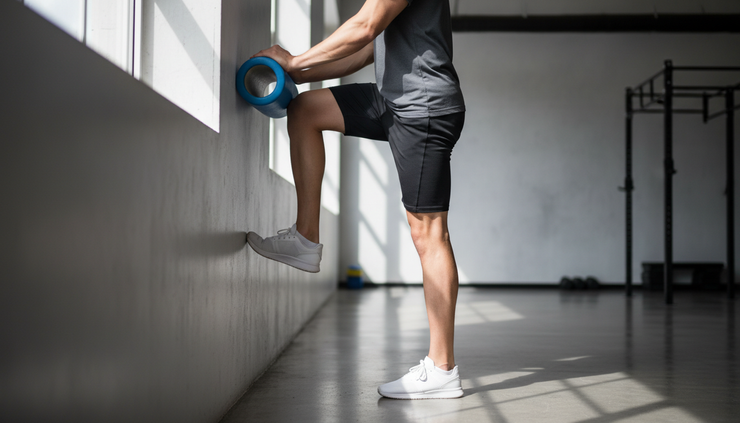
Stand side-on beside a wall. The leg closest to the wall is lifted with the knee bent. Place a foam roller, soft ball, or similar object between that wall-side knee and the wall. Press the knee gently into the object.
The outside leg stays on the floor. This is the stance leg. Keep the pelvis level and avoid letting the body lean or twist. The goal is to balance while the wall-side knee presses into the wall.
This creates an isometric stability challenge, especially for the hip of the stance leg. The stance-leg gluteus medius has to help keep the pelvis stable while the opposite leg applies pressure into the wall.
Key coaching points:
Stand tall without locking the knee
Keep the pelvis level
Press gently, not aggressively
Maintain steady breathing
Hold for 15 to 30 seconds each side
This drill is especially relevant to running because it trains control in a single-leg position. It also teaches the athlete what stable pelvic control feels like without needing heavy load straight away.
Activation is useful, but capacity wins
Activation drills have a place. Clamshells, band walks, wall presses, and balance drills can improve awareness and prepare the body for harder work. They can also help an athlete reconnect with muscles that are not contributing well during movement.
But activation alone is not enough.
Running places meaningful loads through the body. Sport often adds sprinting, cutting, jumping, contact, fatigue, and unpredictable movement. To prepare for that, muscles and tendons need progressive loading.
That means gradually building strength through exercises such as:
Romanian deadlifts
Hip thrusts and bridges
Split squats
Calf raises
Step-ups
Single-leg Romanian deadlifts
Single-leg squats or squat variations
Loaded carries and trunk control work
These exercises build usable strength because they ask the body to produce and control force under increasing demand.
Romanian deadlifts build hip-hinge strength
Romanian deadlifts train the hamstrings, glutes, and spinal stabilisers. They teach the hips to hinge while the trunk stays organised. For runners, this can support stronger hip extension and better posterior-chain capacity.
Good technique matters more than load at first. Keep the ribs and pelvis controlled, push the hips back, and feel tension through the hamstrings. The movement should not become a lower-back exercise.
Hip thrusts and bridges target hip extension
Hip thrusts and bridges are useful for strengthening the glutes through hip extension. They can start as bodyweight floor bridges and progress to loaded hip thrusts.
The key is to finish the movement through the hips rather than overextending the lower back. Think about bringing the pelvis to neutral and squeezing the glutes at the top.
Split squats connect strength to single-leg control
Split squats are valuable because they blend strength, balance, hip control, and lower-limb coordination. They are not identical to running, but they build qualities that running uses.
Start with bodyweight or light external load. Control the descent. Keep the front knee tracking comfortably over the foot. Progress slowly by increasing range, load, or tempo.
Calf raises build lower-leg capacity
The calves play a major role in running. They help control the ankle, store and release elastic energy, and contribute to push-off.
A complete strength plan should include both straight-knee and bent-knee calf raise variations. This helps train the gastrocnemius and soleus, both of which work hard during running.
How to build this into a runner’s week
A good programme does not need to be complicated. The main goal is consistent, progressive work that fits around running rather than competing with it.
For many runners, two strength sessions per week is a practical starting point. Athletes with higher training loads may need more careful planning. Beginners may start with shorter sessions and fewer exercises.
A simple structure could look like this:
Exercise focus | Example options | Training goal |
Hip stability | Clamshells, wall-supported glute medius holds | Improve awareness and control |
Hip extension strength | Romanian deadlifts, hip thrusts, bridges | Build glute and hamstring capacity |
Single-leg strength | Split squats, step-ups, single-leg RDLs | Improve stance-leg control |
Lower-leg strength | Straight-knee and bent-knee calf raises | Build calf and Achilles capacity |
Progress can come from more load, more control, greater range of motion, slower tempo, or more challenging single-leg positions. It does not always mean adding weight every week.
Place harder strength work away from key running sessions when possible. Heavy lower-body lifting the day before intervals or a long run may affect performance. By contrast, easier activation and stability drills can often sit well in a warm-up or recovery session.
Listen to feedback from the body. Soreness can happen, especially when starting. Sharp pain, worsening symptoms, or changes in running gait are signs to adjust and seek professional guidance if needed.

The takeaway for running longevity
The posterior chain helps drive running. The lateral hip helps control it. Both matter.
Strong glutes, hamstrings, calves, and hip stabilisers can support better force production, smoother movement, improved load tolerance, and long-term training capacity. The gluteus medius adds a key piece by helping control the pelvis and femur during single-leg activity.
Clamshells and wall-supported glute medius drills are useful tools. They teach control and build awareness. But runners and athletes should not stop there. The body needs progressive, appropriately loaded strength work to build the capacity that running and sport demand.
Running longevity comes from many parts working together: smart training, recovery, consistency, strength, mobility, nutrition, and patience. Build the chassis as well as the engine, and the miles have a stronger foundation.


Comments